
Stanmore Country Park

Stanmore Country Park lies just north of Stanmore Station on the slopes of the hill leading up to Wood Farm to the north. On warm summer weekends it is busy with walkers and visitors; on a frosty winter’s day it can be deserted of people but loud with passing birds and foraging muntjak deer. The reserve is open all year round and welcomes all visitors. All that we ask of visitors is that you treat the site with respect – that includes not dropping litter, not picking flowers or fungi, not lighting fires, not damaging trees or fences, and keeping dogs under control.
The open space is managed by voluntary wardens who work to record species and enhance the site’s biodiversity. Larger scale work, such as mechanical cutting of the open areas to prevent scrub growth, is performed by council workers and contractors.

The lower parts of Stanmore Country Park lie on the heavy, impermeable London Clay. As the ground rises to the north, successively faster draining soils overlay the London Clay: first the Claygate Beds and then the rounded pebbles of the Stanmore Beds. As the Stanmore Beds and Claygate Beds drain freely, water washes nutrients out of the surface layers causing the soil to be acid. This means that very different ecologies can be seen on Stanmore Country Park within a few metres of each other.
Up to around 1950 Stanmore Country Park comprised grazed open fields. However secondary woodland has grown up over much of Stanmore Country Park, with only small sections remaining as open grassland. Management by volunteers has slowly reclaimed and enlarged these open grassland areas with their unusual wildflower mix.
A Nature Trail 2.3km long winds through Stanmore Country Park and takes visitors past many interesting aspects of the site. Leaflets are usually available in dispensers at the main entrances. Alternatively use one of these sources:
Version suitable for smartphones can be accessed here - or by QR tags on the posts as you walk the trail. This is the most complete version of the guide.
Text version suitable for printing and taking along with you, but without maps or illustrations.
Full PDF copy of leaflet, with maps and illustrations - but note this is intended to be printed on A3 paper; if printed on A4 text size will be very small.

Above: Tormentil
The open areas with acidic, fast draining soil are dominated by common bent and Yorkshire fog. Damper areas are dominated by tussocks of tufted hair grass. Heath bedstraw, lesser stitchwort, red fescue, false oat-grass, tormentil and sheep's sorrel also occur here. Wild angelica and marsh thistle make up the taller elements of this community, whilst spikes of bugle and trailing stems of large birdsfoot trefoil bloom in a profusion of purple and yellow beneath. Remote, pendulous and wood sedges, marsh thistle and jointed rush can also be found. One of the more interesting plants to occur here is square stemmed St John's wort, an uncommon plant in London. Rough grassland is relatively rare in England, especially in the SouthEast, and the open areas in Stanmore Country Park are therefore the most valuable in terms of biodiversity.
A striking feature of the acid grassland are the many raised nests of the Yellow Hill Ant Lasius flavus. Some of the less competitive herbs such as heath bedstraw, common tormentil (picture above), sheep's sorrel and lesser stitchwort thrive on their summits. In a number of locations the ant nest mounds march on into the woodland like overgrown gravestones, an indication that these areas were open grassland relatively recently. In our management of the Park we are working to clear these areas of the newly developed woodland, since seeds of the grassland plants are likely to be still viable in the soil, allowing rapid regeneration of the species-rich grassland. Around the edge of the open areas, particularly Forty Acre field, dog rose is magnificent for a brief few weeks in June.

Above: Blackthorn blossom at edge of 40 Acre Field
Most of the woodland is formed largely of relatively young oak, birch and sycamore, with sporadic occurrences of rowan, holly, english elm, hawthorn and elder in the shrub layer. The wild service tree, which is relatively rare in London, is also found. Other areas of woodland are more open and contain mature beech, hornbeam and oak, with an understorey of holly, birch, elder and hawthorn. Hornbeam, in particular, is more characteristic of ancient woodland, so these sections have probably been wooded for many centuries. Blackthorn with its savage thorns is common throughout the reserve, especially in wet areas along the streams. In April its white flowers on the bare stems are an early promise of Spring; later it bears small bitter plums called sloes that can be used to flavour gin.

Above: Western scaly male fern Dryopteris affinis at nature trail post 3
The woodland supports a good fern and bryophyte flora. On the drier woodland floor are shade tolerant plants including bluebell, enchanter's nightshade, pignut, slender false-brome, herb robert and wood poa, whilst wood anemones generate a splash of white along woodland margins in the spring. Wood sorrel is rare within the site but can be found in the ground flora of the older woodland.
The ponds at the southern corner of the site are balancing ponds dug in the 1980s to protect the nearby underground car park from flooding. Plants to be found there include water plantain, reed mace, false-fox sedge, great willow herb, floating sweetgrass, soft rush, broad-leaved pondweed, pendulous sedge, and celery leaved buttercup.
How to find the reserve
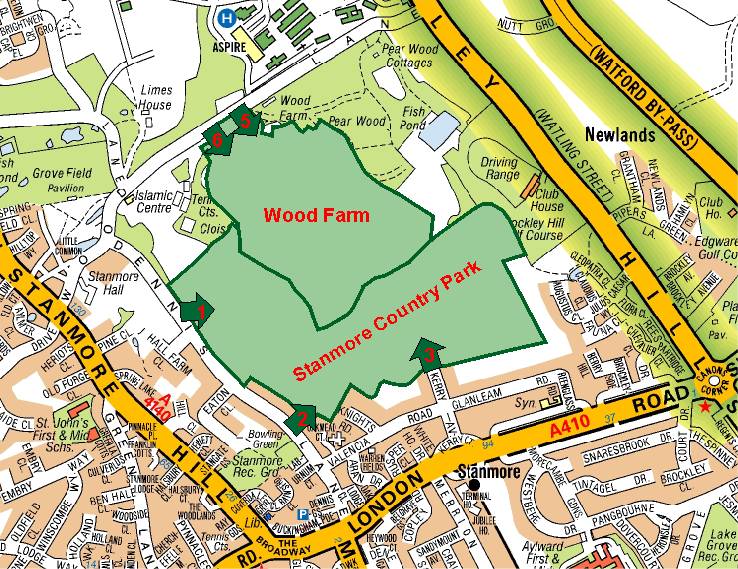
Map above reproduced by permission of Geographers' A-Z Map Co. Ltd. (c)Crown Copyright 2009. All rights reserved. Licence number 100017302.